
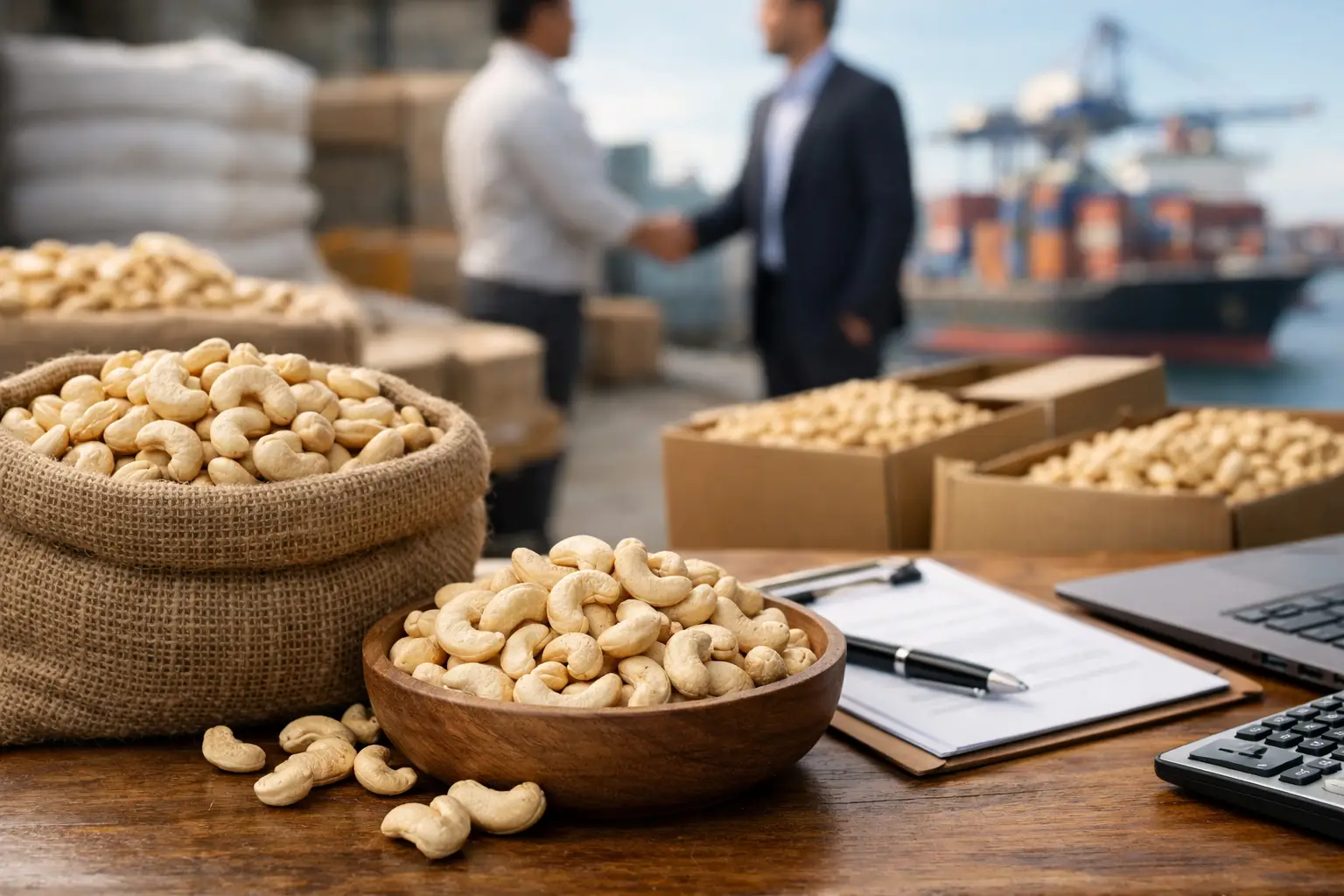
A delayed cashew shipment can do more than leave warehouse space empty. For a distributor, food manufacturer, retailer, or ingredient buyer, it can interrupt packing schedules, strain customer commitments, and force last-minute purchases at unfavorable prices. Choosing the right cashew nuts wholesale exporter is therefore a procurement decision that affects margins, inventory continuity, and customer confidence.
Cashews may appear straightforward as a commodity, but commercial purchasing involves important variables: kernel grade, appearance, moisture, packaging, origin, documentation, transit planning, and supplier accountability. A dependable export partner helps buyers turn those variables into a clear and repeatable supply program.
What Commercial Buyers Should Expect From a Cashew Nuts Wholesale Exporter
Wholesale cashew procurement should begin with specifications, not assumptions. A supplier should be able to discuss the product in the terms that matter to your operation, including the intended application, required grade, target volume, packing format, destination, and delivery schedule.
For resale, buyers may prioritize attractive whole kernels, uniform color, and retail-ready consistency. For food processing, bakery production, confectionery, dairy alternatives, or ingredient blending, the right choice may be a specific grade that balances appearance and cost. Whole white kernels often command a premium, while pieces, splits, and broken grades can offer better value where visual presentation is less critical.
A qualified exporter should communicate these distinctions clearly. If a quote does not identify the grade, kernel condition, packing details, and commercial terms, it is difficult to compare it fairly with another offer. The lowest headline price is not always the lowest landed cost once quality variation, claims, delays, or repacking requirements are considered.
Grade Selection Should Match the End Use
Cashew grades are commonly differentiated by kernel size, whether the kernels are whole or broken, color, and permissible defects. Large whole grades may suit premium retail packs, hospitality suppliers, and applications where the nut remains visible. Smaller whole grades can work well for general distribution, while pieces and splits are often practical for granola, sauces, nut butters, snack mixes, and industrial food production.
There is no universally best grade. The best grade is the one that supports your product positioning and cost target. A buyer selling premium roasted cashews may require consistent whole kernels, while a manufacturer using cashews as an input may gain more from a dependable supply of pieces at a competitive bulk price.
This is where transparent supplier communication matters. The exporter should confirm whether quoted product is raw or roasted, whole or broken, and what quality tolerances apply. Product samples and pre-shipment confirmation can be particularly valuable for new supplier relationships or high-volume programs.
Quality Control Protects More Than Product Appearance
Cashew quality is not limited to a clean-looking kernel. Buyers should evaluate the controls behind the shipment, including sorting, handling, moisture management, packaging integrity, and inspection procedures. Small differences in storage or handling can affect freshness, texture, shelf life, and buyer acceptance after delivery.
Before confirming a wholesale order, establish the specifications that matter to your market. These can include grade, color profile, moisture range, broken-kernel tolerance, foreign-material limits, crop or packing date, packaging material, and labeling requirements. The required standards depend on the product, destination, and buyer’s own regulatory obligations.
For many international purchases, documentation is as important as the physical product. Depending on the destination and transaction structure, buyers may require a commercial invoice, packing list, certificate of origin, bill of lading or airway bill, phytosanitary or health-related documents where applicable, and inspection records. A responsible exporter will clarify document availability before shipment rather than treating paperwork as an afterthought.
Plan the Shipment Before You Confirm the Price
A competitive offer only creates value when the product arrives in usable condition and on a schedule that supports your operation. International cashew procurement requires early planning around lead time, port routing, container availability, customs procedures, and inland delivery.
Buyers should discuss the agreed Incoterm carefully. EXW, FOB, CFR, CIF, and DDP structures assign different responsibilities for freight, insurance, clearance, and risk transfer. The right arrangement depends on your import capability, logistics partners, destination market, and appetite for direct control. Experienced importers may prefer to manage ocean freight independently, while buyers seeking a more coordinated transaction may value an exporter that can support delivery planning through the selected shipping terms.
Packaging also deserves attention. Bulk cashews are commonly packed in formats designed to protect the kernels during storage and transport, but the appropriate carton, vacuum packaging, inner liner, bag weight, and pallet configuration depend on the shipping route and warehouse system. Clear packing requirements reduce disputes at destination and simplify receiving for your operations team.
Build a Supply Plan Around Demand, Not Spot Pressure
Spot buying can make sense when demand is uncertain or a buyer is testing a new market. It also exposes the business to price changes, variable availability, and rushed freight decisions. Buyers with predictable consumption often benefit from forecasting volumes and discussing recurring purchase schedules with their exporter.
A supply plan does not need to be rigid. It can include staged deliveries, agreed quality parameters, target shipment windows, and regular updates on market availability. The objective is not to eliminate every market risk. It is to make purchasing decisions earlier, with better information and fewer operational surprises.
For companies managing multiple product categories, there may also be value in working with an export partner that understands broader procurement requirements. Consolidated communication can reduce supplier fragmentation, especially when a purchasing team is coordinating agricultural commodities alongside other industrial purchasing needs.
How to Compare Wholesale Cashew Offers Fairly
When evaluating suppliers, compare like with like. A lower-priced offer may reflect a different grade, smaller kernels, higher breakage tolerance, less protective packaging, a different Incoterm, or excluded logistics costs. Ask suppliers to provide a complete commercial offer so your team can assess total value rather than price alone.
A useful comparison should confirm the product description, quantity, unit of measure, packing configuration, country of origin, shipment period, payment terms, Incoterm, port of loading, destination, and document package. It should also identify how quality concerns will be handled if the delivered product differs from the agreed specification.
Responsive communication is a practical indicator of supplier reliability. During an export transaction, buyers need timely answers on product availability, packing progress, vessel schedules, documents, and shipment status. A supplier that is unclear before an order is placed is unlikely to become more organized once funds and freight are committed.
Choosing a Partner for Long-Term Cashew Supply
The strongest wholesale relationships are built on repeatable performance. Buyers need an exporter that understands the commercial impact of late paperwork, inconsistent grades, unanswered messages, and missed delivery windows. They also need a partner that can communicate honestly when conditions change and help identify workable alternatives.
Ruda Enterprise supports international B2B buyers with Brazilian agricultural sourcing, competitive bulk supply, quality-focused coordination, and responsive export service. For cashew buyers, the priority is simple: establish a clear specification, confirm the transaction terms, and maintain visibility from sourcing through shipment.
A well-managed cashew program gives your business more than a container of product. It gives purchasing teams the confidence to plan production, protect customer commitments, and pursue growth without allowing a critical ingredient to become the weakest point in the supply chain.
